Soccer Ball Size by Age: Which Ball Should You Choose?

Choose a size 3 ball for ages 5–8, size 4 for ages 9–12, and size 5 for older players as a general soccer ball size by age guide. Recommendations differ at age 8, and league rules can set the match size, so check the player’s age division before buying.
What size soccer ball should I choose by age?
Quick answer: Use size 3 for ages 5–8, size 4 for ages 9–12, and size 5 for older players as a general guide. Age 8 is a transition point: Nike recommends size 4 from age 8, while U.S. Soccer starts at age 9. For league play, check the player’s age division and use the size required by the competition, including any exceptions.
- Ages 5–7: Choose size 3.
- Age 8: Check the league rule; recommendations differ.
- Ages 9–12: Choose size 4 as general guidance.
- Age 13 and older: Choose size 5 as general guidance.
How Do Ages Match Soccer Ball Sizes?
For ages 5–8, U.S. Soccer’s starter kit recommends size 3; for ages 9–12, size 4; and for older players, size 5. The age bands differ slightly across common guides:
- Size 3: ages 5–8 in U.S. Soccer’s guide; under 8 in Nike’s recommendation; U6 and U8 under US Youth Soccer’s policy.
- Size 4: ages 9–12 in U.S. Soccer’s guide; ages 8–12 in Nike’s recommendation; U10–U12 under US Youth Soccer’s policy.
- Size 5: older players in U.S. Soccer’s guide, age 13 and older in Nike’s recommendation, and U13–U19 under US Youth Soccer’s policy.
At age 8, recommendations differ: Nike recommends size 4 starting at age 8, while U.S. Soccer starts that recommendation at age 9. US Youth Soccer groups players by age division, assigning size 3 through U8 and size 4 from U10 through U12. A player’s age alone may not identify the required ball near these age boundaries.
For a 7-year-old, size 3 fits both Nike’s under-8 guidance and US Youth Soccer’s U8 policy. For a player near an age cutoff, check the league’s age division before buying, since a competition rule may differ from a general age recommendation. The cited age recommendations assign sizes by age group, not gender.
What Changes the Right Ball Size?
League rules can override a general age-based recommendation, so check the competition’s requirements before buying a ball for team play. Competition rules take priority when they specify a size: US Youth Soccer assigns sizes by age group and allows exceptions from the organization or its State Associations.
Recommendations can differ for players near an age boundary, so age alone may not settle the choice. For example, guidance starts size 4 at age 8 or age 9, depending on the source; US Youth Soccer assigns size 4 through U12 and size 5 from U13. Age boundaries vary across these recommendations, so follow the player’s league rule for competition and use general guidance when choosing a ball outside league play.
Player circumstances may affect the ball you choose for practice, but the cited age-based recommendations don’t assign sizes by gender. The same size categories apply across US Youth Soccer age groups. For skill training, a smaller ball can be an option: Nike identifies size 1 as best for skill work, while IFAB’s match-ball rules describe the ball required for regulation matches. Treat that as a training choice, not a substitute for the competition ball.
Before purchasing, check which situation the ball is for:
- League matches: Use the size required by the league or competition, including any stated exceptions.
- General use: Use age-based guidance, noting that recommendations may differ near age boundaries.
- Skill practice: Consider a smaller training ball if the goal is skill work, then use the required match size for competition.
For regulation matches, IFAB specifies a size 5 ball with a circumference of 68–70 cm and a weight of 410–450 g at the start of play. Match specifications apply to the regulation match ball, not every training ball.
How Can You Check a Ball’s Size?
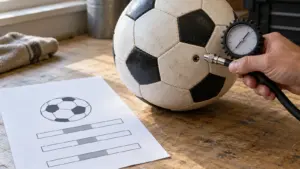
Check the ball’s printed size label, then measure its circumference around the widest part when inflated and compare it with the manufacturer’s specification. Measure when inflated so you’re checking the ball in its playing condition.
Nike lists these circumference ranges by ball size:
- Size 3: 23–24 in
- Size 4: 25–26 in
- Size 5: 27–28 in
If the label is hard to read, the circumference gives you a second check: use the listed range for that size, rather than judging by appearance. A measurement outside the listed range is a reason to check the label and the maker’s specifications before relying on the ball.
For a regulation match ball, check the competition requirements as well as the size label. Those are match-ball specifications, not general measurements for every training ball.
Soccer Ball Size by Age at a Glance
Use size 3 for younger players, size 4 for most older youth players, and size 5 from age 13 in some guidance. The main difference is when players move to size 4: recommendations start at age 8 or 9, so check your league’s rule at that boundary.
| Ball size | Recommended age range |
|---|---|
| Size 3 | Ages 5–8; also listed for under 8 and U6/U8 |
| Size 4 | Ages 8–12 or 9–12; also listed for U10–U12 |
| Size 5 | Age 13 and older, or older players; listed for U13–U19 |
If your child is near an age boundary, follow the league’s competition rule rather than choosing from a general age chart alone.
Frequently Asked Questions
When should a player move up to the next soccer ball size?
Move up when the player reaches the next age group specified by their league or competition. General guidance differs at age 8, so check the league rule before switching; US Youth Soccer assigns size 3 through U8, size 4 from U10 to U12, and size 5 from U13.
What size soccer ball is used for futsal?
Futsal ball sizes aren’t covered by the age-based soccer ball guidance here, so check your league’s futsal rules before buying. For outdoor soccer, use the ball size required by the competition, since those rules can set the match ball size.
How much air should I put in a soccer ball?
Inflate the ball to the pressure printed on its label or specified by its manufacturer. The match-ball rules cited here give size, circumference, and weight requirements, but not an inflation pressure.
Does soccer ball size affect how much it weighs?
Yes, ball size affects which weight specification applies: a regulation size 5 match ball must weigh 410–450 g at the start of play. The age-based recommendations don’t provide weight ranges for sizes 3 and 4, so check the ball’s label or maker’s specifications.
Can you use a regular soccer ball indoors?
Yes, you can use a regular soccer ball indoors if the space and its rules allow it. For a match, use the ball size required by that competition; age-based guidance ranges from size 3 for younger players to size 5 for older youth.
Conclusion
If you’re buying for league play, check the league’s required size and age division first, then choose a ball that meets that rule. For practice or general use, follow the age guidance; if the player is close to an age boundary, confirm the choice with the coach or league before purchasing. Once you’ve settled on the size, check the ball’s label and circumference while inflated to verify it matches the maker’s specification.
Sources
- ussoccer.com (ussoccer.com)
- usyouthsoccer.org (usyouthsoccer.org)
- nike.com (nike.com)
- theifab.com (theifab.com)