Soccer Ball PSI Chart: Find the Right Inflation Pressure
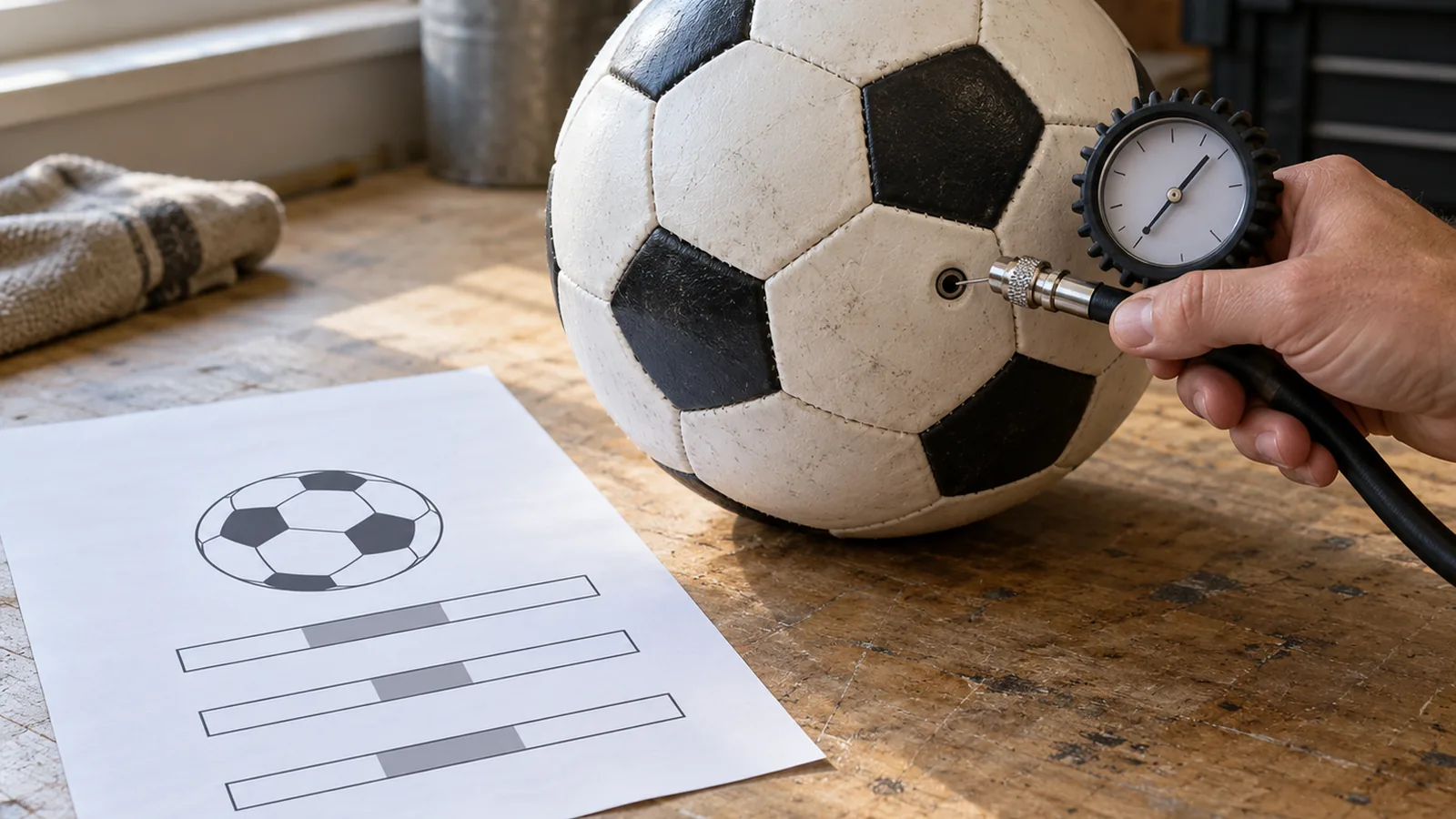
A soccer ball psi chart varies by ball type; regulation match balls are 8.5–15.6 psi at sea level. For your ball, follow the pressure printed beside its valve or on its label, then match the chart to its stated size and category, since one range doesn’t apply to every ball.
What pressure should I use for my soccer ball?
Quick answer: Use the pressure printed beside your ball’s valve, matching the printed unit to your gauge; the right pressure depends on the ball’s size and category. For reference, SELECT’s chart lists size 3 at 5.8–8.7 psi, size 4 at 7.3–10.2 psi, kids’ and club size 5 at 8.7–13.1 psi, and professional size 5 at 10.2–14.5 psi. IFAB’s 8.5–15.6 psi range applies to regulation match balls at sea level, not every soccer ball.
- Check your ball’s stated size and category, then compare them with the chart.
- Read the recommendation beside the valve and match its unit to your gauge.
- Moisten the needle, insert it straight, and pump gradually while checking the gauge.
- Stop at the pressure printed on your ball; overinflating can damage it and affect performance.
How to read the pressure recommendation
Read the pressure marking beside the valve, note whether it’s in psi, bar, or both, and follow the recommendation for that individual ball. A soccer ball psi chart can help you compare listed ranges, but the ball’s own marking is the relevant instruction because recommendations vary.
If the ball lists both psi and bar, use the unit on your pressure gauge, or compare the gauge reading with the matching unit printed on the ball. Match the units before you check or adjust pressure, since a number in psi isn’t interchangeable with a number in bar.
The printed recommendation applies to that ball, while a rule for regulation match balls doesn’t set a universal pressure for every size or type. IFAB’s match-ball specification gives a range at sea level, but that standard is for regulation match balls. For a different ball, use its own printed guidance rather than treating the match-ball range as a general target.
Note
If the marking is hard to read, check the ball’s care instructions for its recommended pressure before inflating; don’t substitute a general chart value for missing labeling.
Use the pressure range as a limit, not a target to exceed: overinflation can damage the ball and affect its performance. The reviewed guidance doesn’t establish one universal PSI threshold for damage, so the printed recommendation is the practical stopping point.
How to inflate and check a soccer ball
Check the ball’s stated pressure. Find the recommendation printed beside the inflation valve, and use that value as your target because recommendations can vary by ball. It may be listed in psi, bar, or both.
Attach a sports-ball needle to your pump. A regular hand pump can inflate a soccer ball when it has the correct sports-ball needle attached.
Moisten the needle. Wet the ball needle before inserting it into the valve.
Insert the needle straight into the valve. Keep it straight as you insert it to inflate the ball.
Pump gradually and check the gauge. Add air in small amounts, checking the pressure as you go; a pressure gauge gives you a measured reading, unlike judging the ball by feel alone.
Stop at the ball’s stated recommendation. Don’t inflate above that pressure: overinflation can damage the ball and affect its performance. The available guidance does not give one universal PSI threshold for damage, so use the recommendation printed on your ball.
What changes the pressure you should use?
The pressure you should use depends on the ball’s size and category, so one pressure doesn’t fit every ball. SELECT’s chart lists different recommendations for size 3, size 4, kids’ size 5, and club size 5 balls. That makes the ball’s stated size a useful way to narrow the recommendation, but the chart does not replace the pressure marking on your specific ball.
Intended use matters when you compare a regulation match ball with other balls: IFAB’s pressure specification applies to regulation match balls, and it does not set a universal range for size 3 or size 4 balls. A match-ball rule, then, is not a general pressure rule for every ball of the same size. For the right target, use the recommendation printed on the individual ball, since manufacturer guidance can vary.
Other than size, category, and the ball’s own stated recommendation, no other factor reliably changes the target pressure. To use a soccer ball psi chart as a check, match the chart’s size and category to your ball, then compare its recommendation with the marking near the valve. If those recommendations differ, follow the marking on your ball rather than treating a chart or match-ball rule as universal.
Soccer ball PSI quick reference chart
Use the ball’s category as well as its size: size 5 recommendations vary by category, so the chart gives SELECT’s ranges separately and lists IFAB’s match-ball range on its own.
| Ball size or category | Recommended pressure (psi) |
|---|---|
| Size 3 | 5.8–8.7 |
| Size 4 | 7.3–10.2 |
| Size 5, kids’ and club | 8.7–13.1 |
| Size 4, professional | 7.3–10.2 |
| Size 5, professional | 10.2–14.5 |
| Regulation match ball at sea level | 8.5–15.6 |
The SELECT chart separates size 5 balls by category, while its size 4 range is the same for club and professional balls. IFAB’s range applies to regulation match balls at sea level. Use the chart as a reference, then follow the pressure printed on your own ball; the individual ball’s recommendation takes precedence. SELECT also lists pressure in bar, while the chart above gives every value in psi.
Frequently Asked Questions
How often should I check my soccer ball’s air pressure?
Check it before use, especially if you’re unsure it has held air since the last session. A pressure gauge gives you a measured reading, while feel alone can’t tell you the PSI. Compare the reading with the pressure printed beside the valve, since recommendations vary by ball.
Why does my soccer ball keep losing air?
A ball that keeps losing air may have a leak, so check it before each session. Check the pressure with a gauge and compare it with the ball’s printed recommendation; if it’s low, add air gradually and stop at that pressure.
How long should a soccer ball stay inflated?
There’s no fixed time period established for how long a soccer ball should stay inflated. Check its pressure before use and inflate it to the recommendation printed on the ball if the gauge reading is low.
Can I use a soccer ball if its pressure is below the recommended range?
Before play, inflate it to the pressure printed on the ball. Pump gradually while checking a gauge, and stop at the stated pressure; inflating above it can damage the ball and affect its performance.
Does cold weather affect soccer ball pressure?
The available guidance doesn’t specify how cold weather changes soccer-ball pressure. Check the ball with a gauge before use, then follow the pressure printed beside its valve rather than guessing by feel.
Conclusion
If your ball’s valve marking is clear, use that pressure and match its units to your gauge. If it’s missing or hard to read, check the ball’s care instructions before inflating; use a chart to compare only when its size and category match your ball. Your next step is to inspect the marking, attach a gauge, and add air gradually until you reach the stated recommendation.
Sources
- Law 2 – The Ball | IFAB (theifab.com)
- select-sport.com (select-sport.com)
- cleatandcone.com (cleatandcone.com)
- stashinc.co.uk (stashinc.co.uk)
- soccervillage.com (soccervillage.com)