Indoor Soccer Ball vs Outdoor: Which Should You Use?
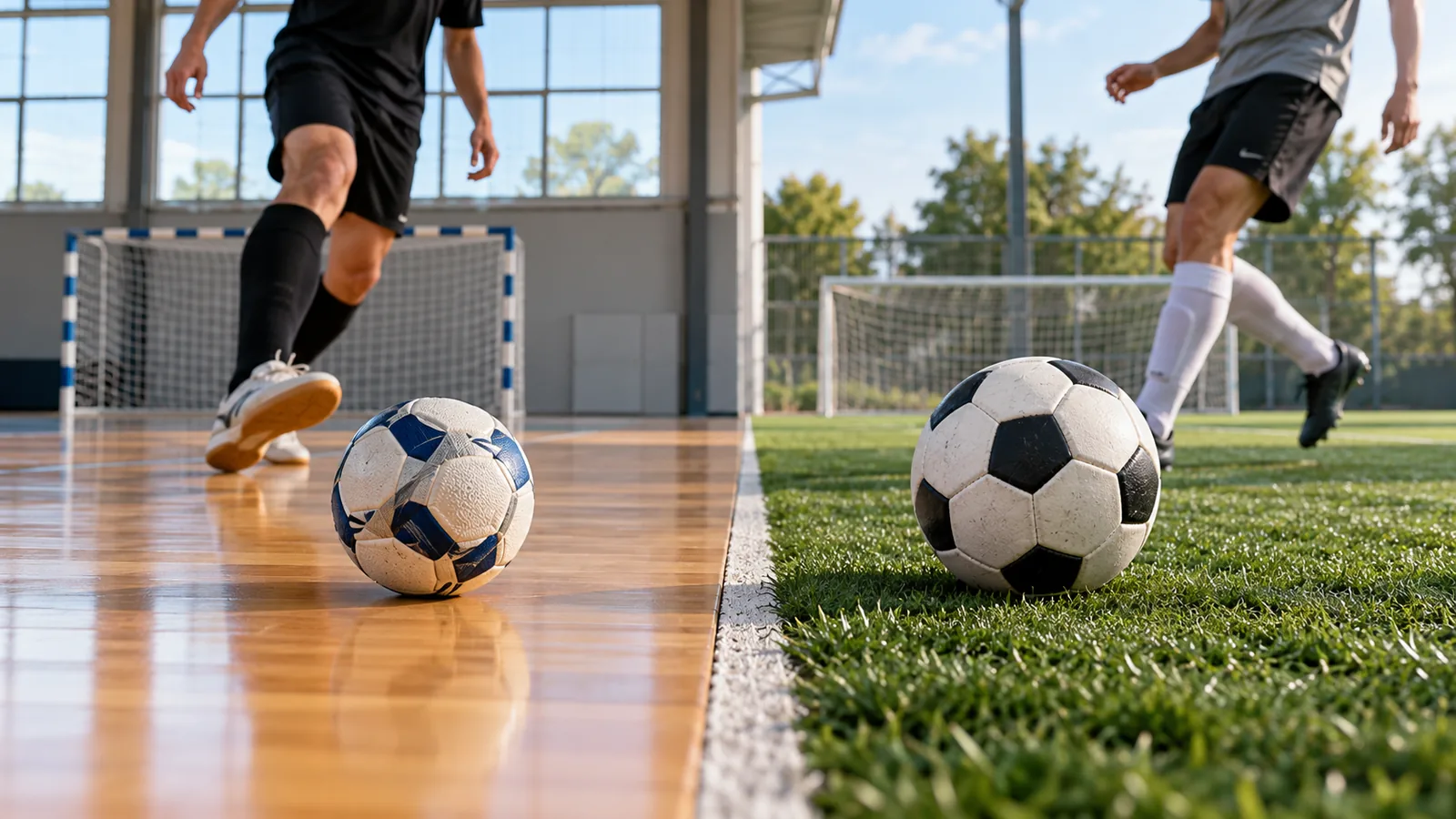
If you’re weighing indoor soccer ball vs outdoor, choose a low-rebound futsal ball for smooth hard courts and a standard outdoor ball for grass or turf. A size-4 futsal ball measures 62–64 cm around, compared with 68–70 cm for a size-5 outdoor ball under the cited rules.
On indoor artificial turf, choose a ball made for turf rather than a smooth futsal court. Check facility and event rules before buying. An outdoor ball’s indoor approval doesn’t make it behave like a regulation futsal ball.
Key Takeaways
- Smooth hard court: Choose a low-rebound futsal ball; use a standard outdoor ball for grass or turf.
- 62–64 cm: A size-4 futsal ball is smaller around than a size-5 outdoor ball at 68–70 cm.
- 50–65 cm rebound: A regulation size-4 futsal ball must rebound this far after a 2 m drop.
- Indoor artificial turf: Choose a ball made for turf, not one designed for a smooth futsal court.
- Size 3: US Youth Futsal recommends this size for players ages 11 and under; check event rules.
Quick Verdict: Match Ball to Surface
For smooth, hard courts, choose a futsal ball; for grass or turf, choose a standard outdoor football.
Hard-court futsal needs low rebound. Futsal balls are designed for smooth courts and controlled bounce, while outdoor footballs are intended for grass or turf. A regulation size-4 futsal ball must rebound 50–65 cm on its first bounce after being dropped from 2 m. IFAB Law 2 sets no equivalent rebound range for outdoor footballs.
Indoor artificial turf is a separate use case from hard-court futsal. Treat it like turf when choosing a ball: guidance favors a standard football for grass or turf, rather than a futsal ball made for a smooth court.
Check facility rules before playing. An outdoor ball may be allowed for recreational use on an indoor court, but it won’t behave like a regulation futsal ball. If you want a ball for formal futsal on a hard court, choose one made to the futsal rules.
The weight ranges overlap, so size and surface fit are clearer reasons to choose than weight alone.
Indoor and Outdoor Ball Specs Compared
Futsal and outdoor balls differ most in circumference and rebound: a regulation size-4 futsal ball is smaller and has a defined first-rebound limit. Their match-start weight ranges overlap, so weight alone won’t tell you which ball fits your court.
| Measure | Size-4 futsal ball | Size-5 outdoor ball |
|---|---|---|
| Circumference (cm) | 62–64 | 68–70 |
| Match-start weight (g) | 400–440 | 410–450 |
| Pressure at sea level (atmosphere) | 0.6–0.9 | 0.6–1.1 |
| First rebound from 2 m (cm) | 50–65 | — |
The futsal rebound rule is designed for play on smooth hard courts. IFAB Law 2 gives no equivalent outdoor rebound range, so the dash does not mean outdoor balls have a particular rebound value. Match the ball to the surface, rather than treating the measurements as interchangeable.
How Rebound and Construction Change Play
Futsal balls are built for smooth hard courts, where low rebound helps keep the ball from bouncing high after it hits the floor. That changes the feel of play: the ball stays closer to the surface after a bounce, unlike a standard outdoor ball, which isn’t designed around the same futsal rebound behavior.
SELECT attributes its futsal balls’ low-rebound behavior to a specialized butyl bladder and polyester fibers. Those materials are part of SELECT’s construction approach, not a universal recipe for every futsal ball.
Indoor artificial turf is a different surface from a smooth futsal court, so a ball made for turf may be built for a livelier response. Baden’s indoor-turf ball combines a glossy cover, reinforced rubber bladder, and foam backing; the foam is intended to create a lively response. Baden also designs that ball to withstand impacts with turf and walls.
Outdoor construction varies by model, rather than following one rule for every outdoor ball. SELECT describes outdoor models with synthetic-leather covers and different bladder options. That means the indoor-versus-outdoor label alone doesn’t tell you exactly how a ball is built or how it will feel.
Using a ball on a surface it wasn’t designed for may shorten its useful life. There’s no established wear rate that applies to every ball and surface. An outdoor ball may be allowed for recreational play on an indoor court, but its rebound and play differ from a regulation futsal ball.
What Prices Can You Compare?
The listed examples span about $30–$120 for outdoor balls, while SELECT’s futsal listings run from $40 to $100. These are examples, not a complete market survey, and comparable current prices for purpose-made indoor-turf balls weren’t found.
| Ball listing | Price (USD) |
|---|---|
| SELECT Futsal Magico Shiny | $40 |
| SELECT Futsal Super TB | $100 |
| adidas Trionda League outdoor ball | $29.99 |
| adidas Trionda Pro outdoor ball | $99.99 |
| SELECT WPSL Super match ball | $120 |
Chart of the table above.
Prices depend on the specific ball, not just whether it’s for futsal or outdoor play. Outdoor examples include both a lower-priced option and match-ball listings near or above the SELECT futsal examples, so prices vary within each category.
Baden’s $13.99 molded-rubber recreational ball is marketed for indoor and outdoor use, but it isn’t a purpose-made indoor-turf ball and doesn’t establish a representative price for that category. If you’re shopping for indoor artificial turf, compare balls specifically designed for that surface rather than using this recreational ball’s price as your benchmark.
Which Ball Should You Choose?
Choose the ball for the surface your player will use most.
Hard-court indoor player: Choose a futsal ball designed for smooth courts and low rebound. It’s built for hard-court play, where a standard outdoor ball’s rebound and response differ.
Outdoor grass or turf player: Choose a standard outdoor football for grass or turf. SELECT guidance favors a standard football over a futsal ball on these surfaces.
Artificial-turf player: Choose a ball made for indoor turf, rather than treating turf like a smooth futsal court. Baden’s indoor-turf ball has a glossy cover, reinforced rubber bladder, and foam backing intended to give it a lively response.
Family choosing for a young futsal player: Start with the age-based size recommendation, then check the event rules. US Youth Futsal recommends size 3 for ages 11 and under and size 4 for ages 12 and over; competition requirements may vary.
If your facility permits it, you can use an outdoor ball recreationally on an indoor court. It won’t behave like a regulation futsal ball, so choose a futsal ball for hard-court futsal play.
Frequently Asked Questions
Is a futsal ball the same as an indoor soccer ball?
No. A futsal ball is made for smooth hard courts and low rebound, while indoor artificial turf is a different use case that calls for a turf-designed ball. Check what surface your facility has before choosing, since “indoor” can mean either surface.
Can you use an indoor soccer ball outside?
Yes, if it’s designed for the outdoor surface you’re playing on. A futsal ball is intended for smooth hard courts, while standard outdoor footballs are favored for grass or turf. Indoor turf and outdoor turf are separate settings, so check the ball’s intended use.
Which type of soccer ball is more durable?
Neither type is universally more durable, because construction varies by model. Choose a ball designed for your surface: Baden says its indoor-turf ball is built to withstand turf and wall impacts, while its recreational molded-rubber ball is marketed for indoor and outdoor use.
Can using a ball on the wrong surface shorten its life?
Yes. Using a ball on a surface it wasn’t designed for may shorten its useful life, though there’s no established wear rate that applies to every ball and surface.
Should I buy separate balls for indoor and outdoor soccer?
Yes, if you play both hard-court futsal and outdoor soccer. A futsal ball is designed for low rebound on smooth courts, while a standard outdoor ball is intended for grass or turf. For indoor artificial turf, look for a ball made for that surface rather than a hard-court futsal ball.
Conclusion
If you’ll play mostly on a smooth hard court, pick a futsal ball; if you’ll play on grass or outdoor turf, pick a standard outdoor ball. Before buying, check your facility’s rules and match the ball’s stated surface to where you’ll use it most.
Sources
- The website for the English football association, the Emirates FA Cup and the England football team (thefa.com)
- Law 2 – The Ball | IFAB (theifab.com)
- badensports.com (badensports.com)
- bounceathletics.com (bounceathletics.com)
- usyouthfutsal.com (usyouthfutsal.com)
- catalogs.asbsports.com (catalogs.asbsports.com)
- unisportstore.com (unisportstore.com)
- badensports.com (badensports.com)
- us.select-sport.com (us.select-sport.com)
- soccer.com (soccer.com)
- us.select-sport.com (us.select-sport.com)