
FG vs AG vs TF Soccer Cleats: Which Should You Choose?
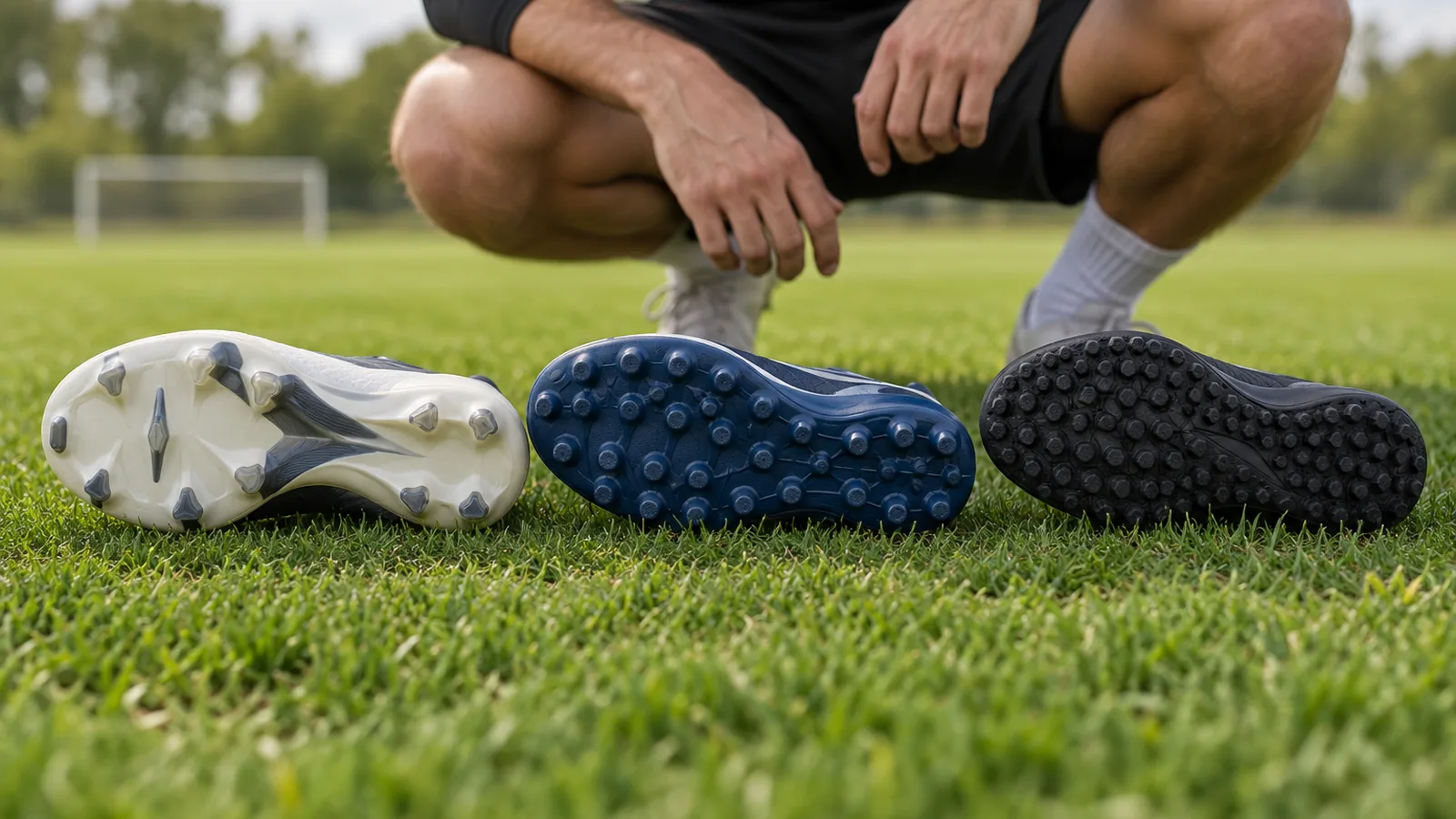
For fg vs ag vs tf soccer cleats, choose FG for firm natural grass, AG for artificial grass such as 3G pitches, and TF for short-pile or harder turf. Check your boot maker’s guidance and field rules before using FG on artificial grass, since recommendations differ.
Which should you choose: FG, AG, or TF soccer cleats?
Quick answer: Match the outsole to the field: choose FG for firm natural grass, AG for modern artificial grass such as 3G or 4G, and TF for short-pile or older, harder turf. The field surface determines your choice. If you regularly switch between natural grass and artificial surfaces, consider multi-ground boots. Check the field rules and the specific boot maker’s guidance before using FG on artificial grass, since recommendations differ.
- Firm natural grass: Choose FG, with molded studs designed for dry or slightly damp pitches.
- Modern artificial grass: Choose AG, whose outsole spreads studs across the soleplate.
- Short-pile or harder turf: Choose TF, with many small rubber lugs.
How do FG, AG, and TF cleats compare?
The main difference is how each outsole contacts the surface: AG spreads studs across the soleplate, while TF uses many small rubber lugs instead of grass-boot studs. The fg vs ag vs tf soccer cleats choice depends on your field’s surface and, for artificial grass, the field rules and boot maker’s guidance.
| Type | Intended surface | Outsole or stud design | Practical use |
|---|---|---|---|
| FG | Firm natural grass | Studs provide traction without penetrating the pitch too deeply | Match the outsole to firm natural grass |
| AG | Artificial grass, especially modern 3G and 4G pitches | More studs spread across the soleplate; layouts vary by model | Designed to distribute pressure on harder synthetic surfaces |
| TF | Artificial turf, particularly short-pile or older, harder turf | Many small rubber lugs | Use on turf surfaces suited to turf shoes |
Guidance for FG boots on artificial grass varies. England Football accepts molded plastic-stud FG boots, while the FA notes that blades may not be recommended and local rules matter. Check your club’s surface rules and the boot maker’s advice before using FG boots on artificial grass. AG stud height, count, spacing, and shape vary by model.
What changes between FG and AG outsoles?
FG and AG outsoles differ in stud layout and intended surface: FG studs grip firm natural grass, while AG spreads contact across artificial grass. AG uses more studs across the soleplate to distribute pressure on harder synthetic fields.
FG boots use molded, non-removable studs for dry or slightly damp natural grass. Their studs are designed to provide traction without penetrating the pitch too deeply. Nike warns that hard, shallow 3G and 4G fields can catch FG studs, which may raise injury risk and damage the boot.
AG boots are designed for artificial grass, especially modern 3G and 4G pitches. Their greater number of studs helps spread pressure across the sole, reducing pressure from individual studs on harder synthetic surfaces. AG studs may be shorter, rounded, or hollowed out, but designs vary by model.
There’s no universal AG stud length or spacing to compare against FG. Check the specific boot’s outsole and the maker’s surface guidance rather than relying on a fixed measurement. England Football recommends AG boots for 3G or artificial pitches, though molded plastic-stud FG boots are also acceptable; check with your club if you’re unsure about the field.
AG boots can work on very dry, hard natural grass, but Nike doesn’t recommend them for typical grass pitches because shorter, rounded studs may not give you enough grip. If you regularly move between natural grass and artificial surfaces, multi-ground boots are another option.
When should you choose TF over cleats?
Choose TF shoes for short-pile or older, harder artificial turf, where their many small rubber lugs suit the surface better than grass-boot studs.
TF shoes are a turf-specific option, not a general substitute for cleats on every field. Use them when you play on short, hard synthetic turf; for modern 3G or 4G artificial grass, AG boots are designed for the surface, and FG boots are intended for firm natural grass.
TF shoes also differ from indoor soccer shoes. Raised rubber lugs suit synthetic grass, while indoor shoes have a flat rubber outsole for hard courts such as gym floors and futsal courts. If you play indoors on a hard court, choose indoor footwear rather than TF shoes.
If a venue’s surface is unclear, check its rules before choosing footwear. The FA notes that local site rules matter on 3G turf, and molded studs are normally acceptable while blades may not be recommended.
Our pick: match the outsole to your field
Choose your cleats by the surface you play on most: for fg vs ag vs tf soccer cleats, match the outsole to that field. FG boots suit dry or slightly damp natural grass, AG boots are designed for artificial grass, and TF shoes suit artificial turf, especially short-pile or harder surfaces.
- Mostly natural grass: Choose FG boots for firm pitches; switch to soft-ground boots when the grass is heavily waterlogged or muddy.
- Mostly 3G or 4G artificial grass: Choose AG boots, which are designed for these pitches.
- Mostly short-pile or older, harder turf: Choose TF shoes, whose small rubber lugs are intended for artificial turf.
Nike recommends them for players who switch between those surfaces, and adidas describes them as suitable for natural and artificial outdoor surfaces. Some PUMA boots are labeled FG/AG for firm natural surfaces and artificial grass, including 4G, but that guidance applies to those specific models.
Check your field’s rules and the boot maker’s guidance before choosing boots for artificial grass. Nike says FG boots suit most artificial turfs, while adidas describes FG boots for natural grass and AG boots for artificial grass. England Football identifies AG boots as the best option on 3G or artificial pitches and accepts molded plastic-stud FG boots.
Ask your club if you’re unsure about the surface or its rules.
AG boots can work on very dry, hard natural grass, but Nike does not recommend them for typical grass pitches because their shorter, rounded studs may not provide enough grip.
Frequently Asked Questions
Are TF shoes the same as indoor soccer shoes?
No. TF shoes have raised rubber lugs for synthetic grass, while indoor soccer shoes have a flat rubber outsole for hard courts such as gym floors and futsal courts. Choose TF for turf and indoor shoes for hard courts.
What cleats should you wear on a field with mixed surfaces?
Check the boot maker’s guidance and the field’s rules, since recommendations for FG boots on artificial grass differ.
Are multi-ground soccer cleats better for playing on different surfaces?
Yes, if you regularly play on both natural grass and artificial surfaces, multi-ground boots are designed to suit both. Check the specific boot’s guidance for your fields, since outsole designs and recommendations vary by model.
Do AG soccer cleats feel different from FG cleats?
Yes. AG cleats generally have more, shorter, rounder studs than FG cleats, spreading contact across the sole to reduce pressure on harder synthetic surfaces. The exact stud layout varies by model, so compare the specific outsoles rather than relying on one standard pattern.
Which soccer cleats work best on wet natural grass?
FG cleats suit slightly damp natural grass, while soft-ground boots are the better choice when the pitch is heavily waterlogged or muddy.
Conclusion
If you switch between surfaces, look for a boot explicitly suited to both and check its maker’s surface guidance. Before buying, confirm the field type and ask your club about its footwear rules, especially for artificial grass. Then compare the outsole pattern with the surface you’ll play on most.
Sources
- Firm-Ground Football Boots. Nike UK (nike.com)
- nike.com (nike.com)
- adidas.com (adidas.com)
- prodirectsport.com (prodirectsport.com)
- welcometofootball.englandfootball.com (welcometofootball.englandfootball.com)
- nike.com (nike.com)
- prodirectsport.com (prodirectsport.com)
- adidas.com (adidas.com)
- thefa.com (thefa.com)
- nike.com (nike.com)
- adidas.com (adidas.com)
- us.puma.com (us.puma.com)
