Soccer Goal Size by Age Chart: What Size to Choose
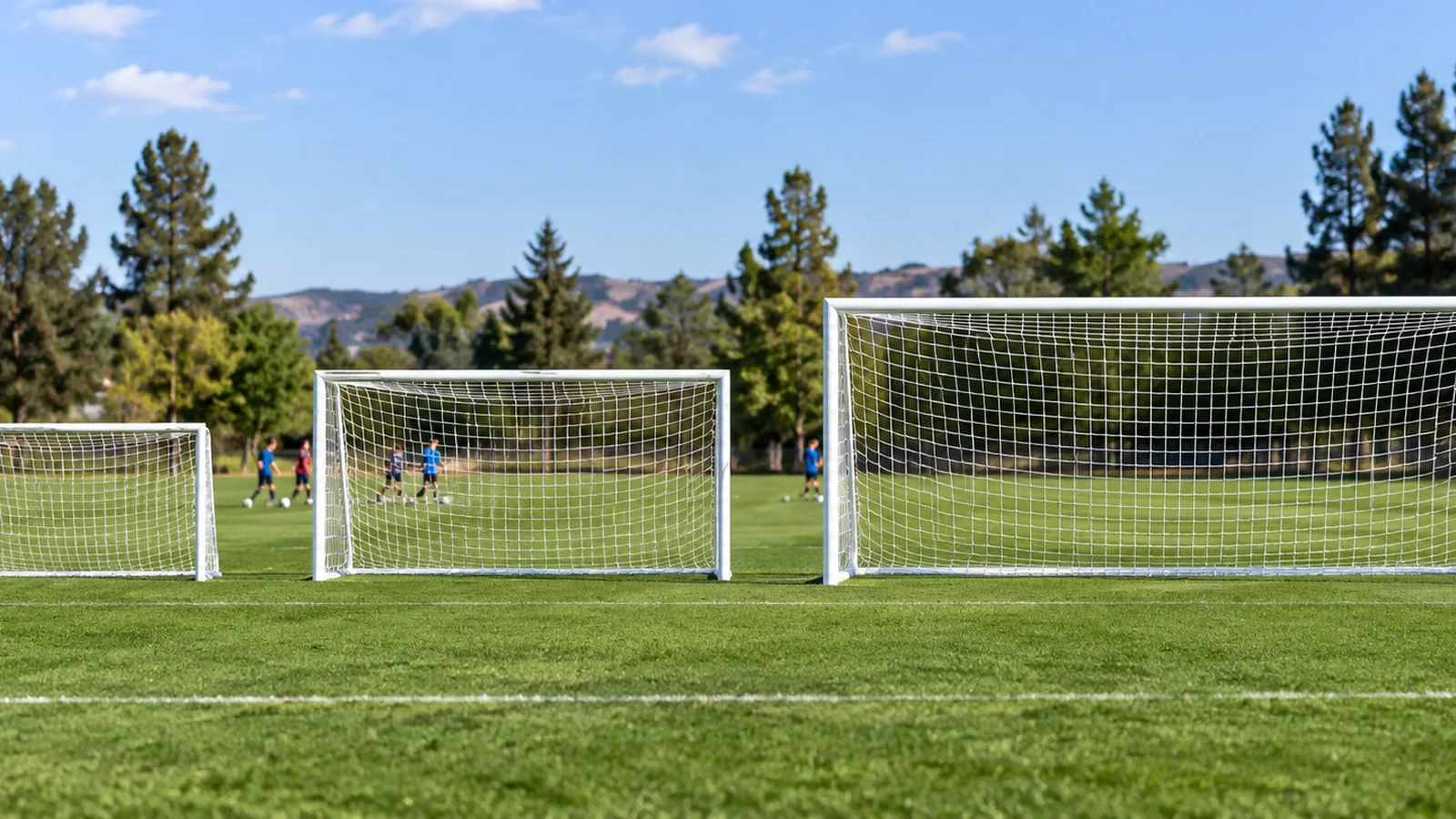
A soccer goal size by age chart starts with 4 × 6 ft goals for players in U6–U8, the youngest listed age groups. The right size still depends on your league’s rules: for U9–U10, AYSO recommends 6.5 × 12 ft, while U.S. Soccer allows a maximum of 6.5 × 18.5 ft. Treat a maximum as a limit, not the default.
What size soccer goal should you choose for each age group?
Quick answer: Choose the goal listed for the player’s registered age group, then confirm your league’s rules: AYSO recommendations and U.S. Soccer maximums differ for some groups. Sizes below are height × width; treat a maximum as a limit, not the default.
- Schoolyard/6U–8U: 4 × 6 ft
- 9U–10U: AYSO recommends 6.5 × 12 ft; U.S. Soccer allows up to 6.5 × 18.5 ft
- 11U–12U: AYSO recommends 6.5 × 18.5 ft; the maximum is 7 × 21 ft
- 13U–19U: AYSO recommends 8 × 24 ft; confirm your competition’s rules
Match goal size to the age group
Ages 6–8 generally use goals up to 4 ft high by 6 ft wide; the next age groups move to larger goals, with the exact recommendation depending on the league’s rules. Use the player’s registered age group, then check whether the competition sets a recommended size or a maximum.
For children in U6–U8, according to AYSO, the researched guidance sets a 4-by-6-ft maximum. For U9–U10, AYSO recommends 6.5 ft high by 12 ft wide, while U.S. Soccer allows up to 6.5 ft high by 18.5 ft wide. That difference matters when choosing: a league’s maximum is not necessarily its recommended size.
For U11–U12, AYSO recommends 6.5 ft high by 18.5 ft wide, with a maximum of 7 ft by 21 ft; U.S. Soccer sets the same 7-by-21-ft maximum. From U13, AYSO recommends 8 ft by 24 ft, and USL Youth lists that size for U13 and older.
Check the age label carefully: U6 means players who are 6 years old and younger in U.S. Soccer’s chart. If the player’s age or team label falls near a boundary, use the competition’s assigned age group rather than choosing from age alone. The chart’s sizes are listed as height by width, so read both dimensions in that order.
U13 play also moves to full-field 11v11 matches, though U.S. Soccer’s guidance doesn’t specify goal dimensions. Under IFAB’s Laws, standard adult goals are 8 ft high by 24 ft wide. Youth dimensions can depend on the competition format and governing rules.
Check which rules set the goal dimensions
Check the competition’s rules before choosing a goal: U.S. Soccer’s youth small-sided standards and IFAB’s Laws cover different formats, so the applicable dimensions depend on the competition and its governing rules.
For U.S. Soccer youth small-sided play, use the Player Development Initiatives as the reference for goal-size limits. AYSO gives Regions discretion over goal and field dimensions, while advising them to follow AYSO or U.S. Soccer small-sided requirements whenever possible. That means an AYSO Region’s chosen dimensions may differ from the recommended size, but should stay within its stated maximum.
Check your league’s current competition rules to confirm which recommendation or limit applies.
The competition’s governing rules determine the applicable size, since age charts don’t cover every league and format. IFAB’s Laws specify standard goals measuring 24 ft wide by 8 ft high, while U.S. Soccer’s youth initiative gives dimensions for small-sided play. U.S. Soccer places the start of full-field 11v11 play at U13, but its guidance doesn’t specify goal dimensions. For a specific match, confirm the competition format and its rules before choosing dimensions.
Choose a goal for practice or play
Choose the goal by the player’s age-group row, then confirm the competition’s rules before using it for a match.
For a match, use the dimensions required by the league or governing body for that competition format. If you’re choosing between a recommended size and a listed maximum, treat the recommendation as the starting point and check whether the league allows a different size.
For practice, start with the same age-group guidance, then check whether your team has a separate requirement. The cited age-based charts don’t set a practice-only goal-size rule. A U.S. Youth Soccer training manual uses 6 × 18 ft goals for U10/U12 and 8 × 24 ft goals for U14 in a training activity; that’s an example, not a separate practice standard.
Soccer goal size by age chart
The soccer goal size by age chart below uses AYSO’s recommended dimensions where available, with U.S. Soccer and IFAB guidance shown where it differs. Sizes are listed as height × width.
| Age group | Applicable guidance | Recommended size (ft, H × W) | Range in sources (ft, H × W) |
|---|---|---|---|
| Schoolyard/6U–8U | AYSO recommendation; U.S. Soccer maximum for U6–U8 | 4 × 6 | 4 × 6 |
| 9U–10U | AYSO recommendation; U.S. Soccer maximum for U9–U10 | 6.5 × 12 | 6.5 × 12–18.5 |
| 11U–12U | AYSO recommendation; U.S. Soccer maximum for U11–U12 | 6.5 × 18.5 | 6.5–7 × 18.5–21 |
| 13U–19U | AYSO recommendation; IFAB standard | 8 × 24 | 8 × 24 |
Treat a maximum as a limit, not the default size; use your league’s rules to decide which guidance applies.
Frequently Asked Questions
How deep should a youth soccer goal be?
Choose a depth that fits the goal’s frame and net, since the age-based guidance specifies goal height and width rather than depth. For a match, confirm the required goal dimensions with your league; its rules determine which guidance applies.
Do portable soccer goals need to be anchored?
Yes, anchor portable goals before use so they stay stable during play. The cited age-based goal guidance doesn’t set anchoring requirements, so follow the goal maker’s setup instructions and any applicable league or facility rules.
How do I measure a soccer goal correctly?
Measure height and width: take the height from the ground to the crossbar, then the width between the posts. Age-based charts list dimensions as height × width, so a 4 × 6 ft goal is 4 ft high and 6 ft wide.
What size net fits a 6-by-4-foot soccer goal?
A net must match the frame’s opening and depth; for a goal listed as 4 ft high by 6 ft wide, look for a net made for those dimensions. Confirm the net’s depth and attachment style against your goal frame, since the age-based charts don’t specify net dimensions.
Can I use a pop-up goal for youth soccer practice?
Yes, if it suits the activity and your team allows it. Youth age-based charts don’t set a separate practice-only goal size, so use the age-group guidance as a reference and check team rules.
Conclusion
If you’re choosing a goal for a match, use the size required by the competition’s rules; if you’re buying or setting up one for practice, start with the player’s assigned age group and confirm the choice with the league or team. That avoids treating a permitted maximum as the default recommendation.
Your next step is to check the current competition rules and verify the goal’s height and width before you commit to a size.
Sources
- wiki.ayso.org (wiki.ayso.org)
- PowerPoint Presentation (cdn2.ottosport.ai, Tue, 17 Dec 2019 00:57:21)
- downloads.theifab.com (downloads.theifab.com)
- usl-youth.com (usl-youth.com)
- ussoccer.com (ussoccer.com)
- ussoccer.com (ussoccer.com)
- ussoccer.com (ussoccer.com)
- usyouthsoccer.org (usyouthsoccer.org)