
Free Kick Drills With Mannequins for Better Practice
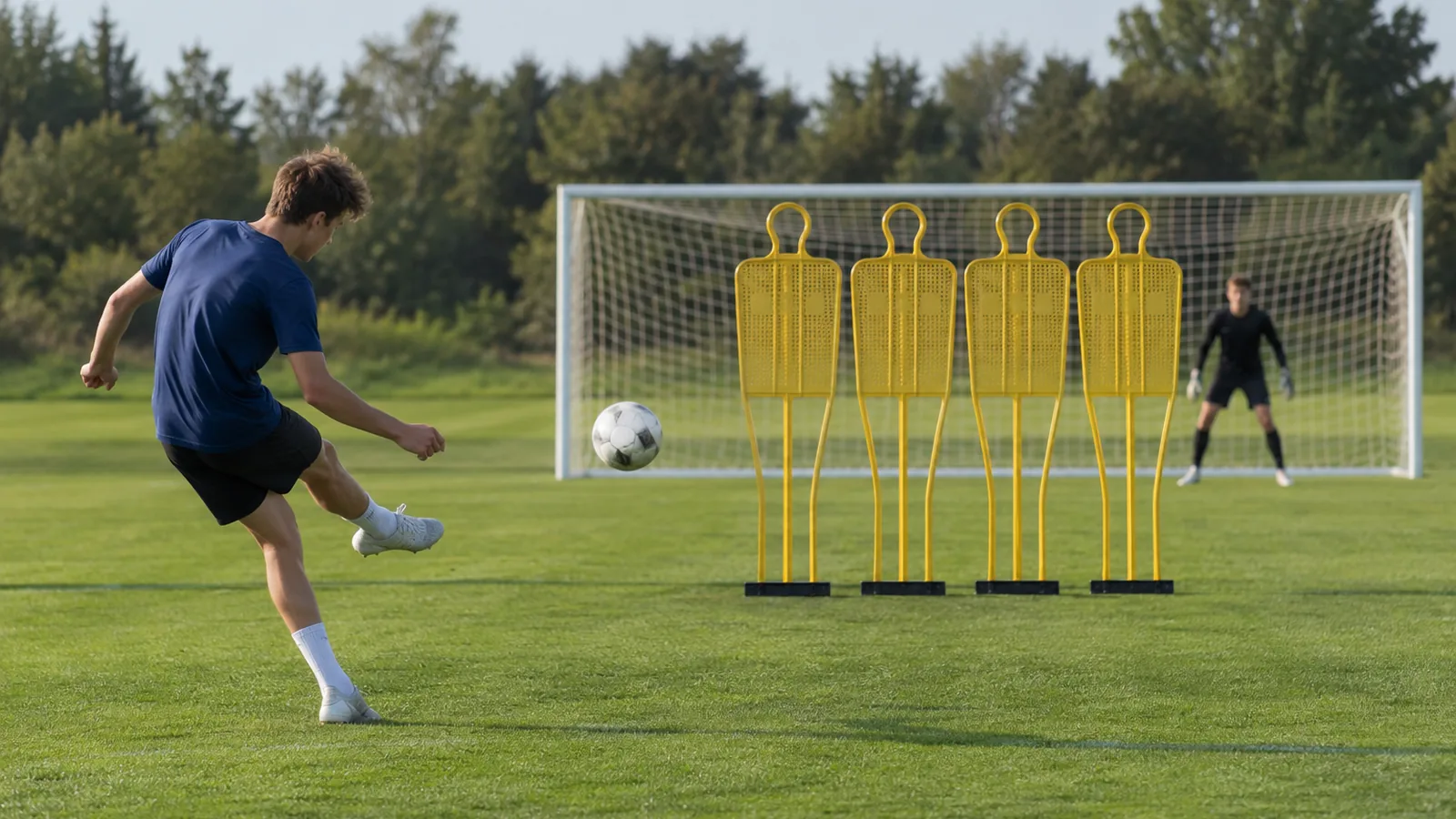
Free kick drills with mannequins use 4 mannequins as a defensive wall, giving you a target to shoot over, around or under. Set the wall 9 m from the ball for the standard drill; move it to 7 m for younger players, and reduce the wall to two mannequins or shorten the distance if clean contact is difficult.
How do you practice free kicks with mannequins?
Quick answer: Set up 4 mannequins as a wall 9 m from the ball, with the ball 20–22 m from a full-size goal and a goalkeeper in goal. Choose your target before the run-up, then practice curling or driving the ball over the wall; progress to shots around and under it, then add a defender who charges out as you touch the ball. For younger players or anyone struggling to make clean contact, use a 7 m wall distance, reduce the wall to 2 mannequins, or shorten the kicking distance.
- Set out 4 mannequins, 15 balls and 4 cones; use the cones to mark the setup.
- Take 3 kicks from each of 3 ball positions: central and to each side.
- Practice 6 shots each over, around and under the wall, then take 4 kicks with your preferred technique.
- Add a defender who charges from the wall when you touch the ball.
Gather the equipment for practice
Start with 4 mannequins, 15 balls and 4 cones for the sourced direct free-kick drill; it also uses a full-size goal and goalkeeper. The cones mark the setup, while the extra balls let players keep the practice moving.
| Item | Count |
|---|---|
| Mannequins | 4 |
| Balls | 15 |
| Cones | 4 |
Chart of the table above.
The four-mannequin layout is one drill’s recommendation, not a universal wall size: other cited examples use three or four mannequins, while beginner options reduce the wall to two. For this setup, gather the four mannequins, balls and cones before practice, and have a full-size goal and goalkeeper available.
How should you set up the mannequin wall?
Choose the ball position. For the standard drill, place the ball 20–22 m from a full-size goal; this gives you the recommended starting distance for the free kicks. A separate drill uses 20–22 yards, so use the metric setup consistently rather than mixing the two.
Set the wall distance. Place the mannequin wall 9 m from the ball. Another drill sets the wall 10 yards (9.15 m) away, which is close to the same distance.
Arrange the mannequins. Start with 4 mannequins to represent the defensive wall. Sources also describe setups with 3–4 mannequins, so the examples don’t establish one standard wall count. For younger players, move the wall to 7 m from the ball.
Check the goal setup. Use a full-size goal and goalkeeper for this drill. No reliable guidance sets a mannequin wall height, so a particular height isn’t a required standard.
Practice placing free kicks around the wall
Choose the target before your run-up. Pick the goalkeeper’s far corner for a curling shot or the near side beyond the wall for a driven shot. Decide first, then keep that target for the attempt.
Curl the ball over the wall. Approach at an angle, strike below the ball’s centre with the inside of your foot, and follow through across your body. Aim for the far corner, where the ball must clear the mannequins and bend toward goal.
Drive the ball over the wall. Strike through the middle of the ball with your laces and keep your body over it. Aim beyond the near end of the wall, using a firm, direct strike rather than the curling technique.
Repeat from different ball positions. Take three kicks from the central position, then three from each side. Have the goalkeeper set the mannequin count and position before each series, so you must read the wall before choosing your target.
Vary the route through a set progression. Take six repetitions each of shots over, around, and under the wall, then finish with four kicks using a technique you choose. For the around-the-wall attempts, aim beside the mannequins; for the over attempts, use one of the two techniques above.
Scale the drill to your level. If the wall makes clean contact too difficult, reduce it to two mannequins or shorten the kicking distance. Another option is to move the ball closer to 16 yards, use two mannequins, and replace the goalkeeper with cone-marked goal targets.
Add movement and decision-making to the drill
Set the target before the run-up. Have the goalkeeper set the mannequin count and position for the next series, then choose a target before you start your approach. This makes you decide on a route before the wall changes the available space.
Change the shot route. Practice shots over, around, and under the wall, with six repetitions of each route. For an over-wall shot, choose either a curl toward the far corner or a driven ball over the near end; for a low attempt, the goalkeeper can call “Jump!” as you strike to represent a jumping wall.
Finish with player-chosen kicks. After the route-based repetitions, take four kicks using your preferred technique. Pick the target and commit to it before the run-up, rather than changing your choice during the approach.
Add a defender who closes you down. Once you can select and execute a route against a set wall, add a defender who charges out from the mannequin wall when you touch the ball. Keep the target decision before the run-up, then respond to the defender’s movement as you take the kick.
Use a runner when the setup calls for it. A runner can disrupt the wall’s timing and open a delivery lane, but match the routine to the defensive setup. This gives you a different decision to make: whether the lane is open for the delivery.
Frequently Asked Questions
How much space should you leave between mannequins?
Set the mannequins close enough to form a defensive wall, using three or four as a practical starting count. The drills specify the wall’s distance from the ball, about 9 m, but don’t give a gap between mannequins; keep the line compact and adjust the number for your level.
How do you keep free kick mannequins from falling over?
Place each mannequin securely according to its base design, and check that it’s stable before you start kicking. The drills call for mannequins as a wall but don’t specify a particular anchoring method, so follow the equipment maker’s setup instructions and keep players clear while you reposition them.
Where should the goalkeeper stand during mannequin free kick practice?
Have the goalkeeper start in the goal while you practice choosing a target against the wall.
How often should you practice free kicks with mannequins?
Use a short, repeatable session rather than setting an unsupported weekly schedule: one drill is designed for 15 minutes. Within that session, take three kicks from each of three ball positions, or progress through six attempts over, around, and under the wall, then four player-chosen kicks.
How can you measure improvement in free kick accuracy?
Track how many kicks reach your chosen target area, using the same goal zones and setup across sessions. The drills cue you to select a target before the run-up and vary the ball position, so record results by target and starting position to see where your accuracy changes.
Conclusion
If you’re still working on clean contact, use a smaller wall or move the ball closer, then focus on one route at a time. If you can strike consistently, keep the wall in place, choose a target before your run-up, and add a defender who closes you down. Set out the mannequins and balls before practice, then start with the version that lets you make a clear decision and execute the kick.
Sources
- Direct Free Kicks Over the Wall – Football Drill (rondomap.com, 2026-10-12)
- askthegaffer.io (askthegaffer.io)
- teamstats.net (teamstats.net)
- vantasports.ai (vantasports.ai)
