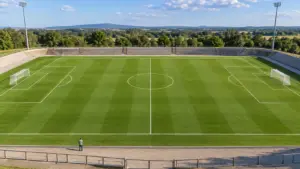
Soccer Field Dimensions by Age: What Size Is Right?
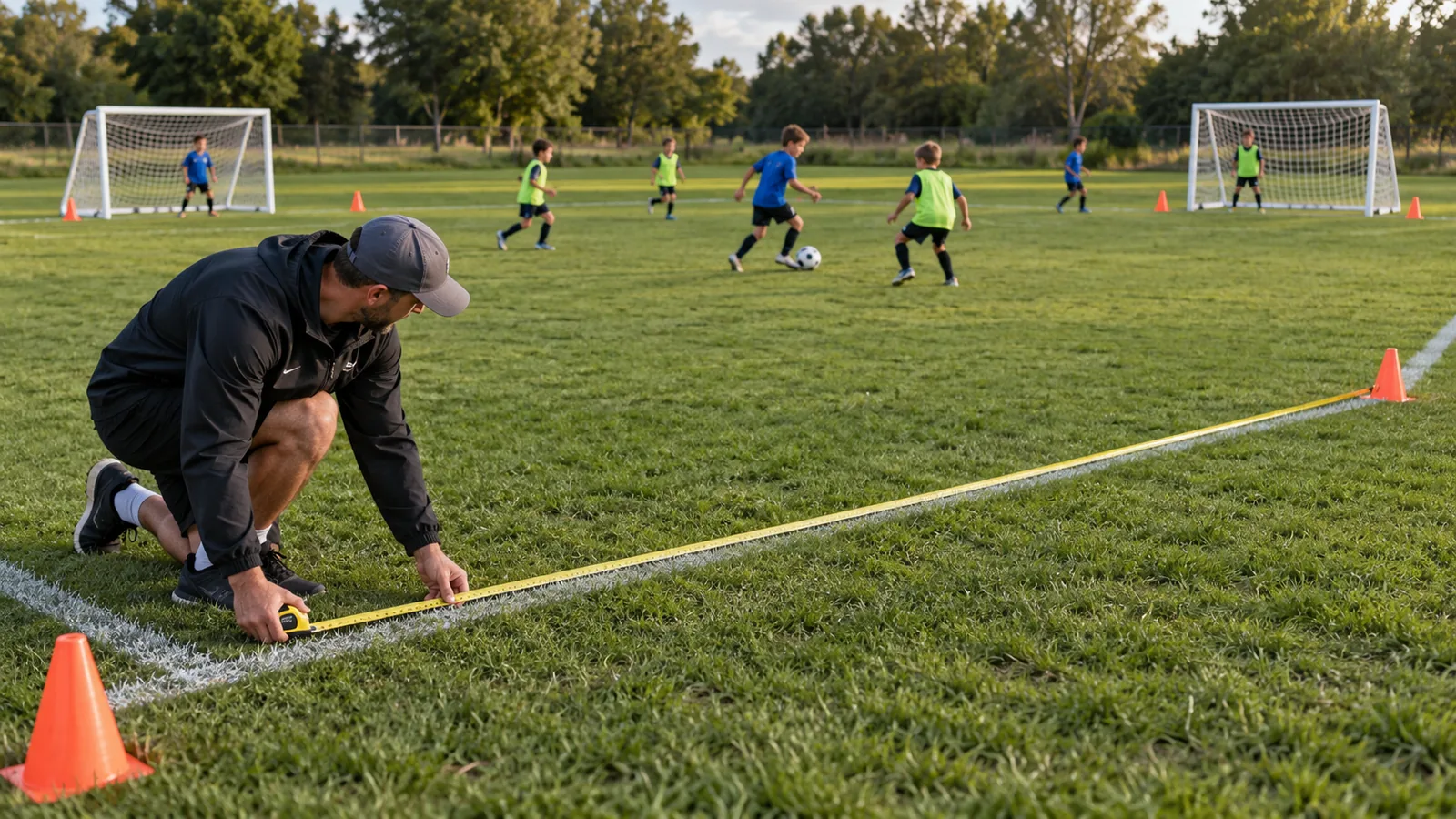
For soccer field dimensions by age, U.S. Soccer recommends 25–35 yd long for U6–U8 fields, with widths of 15–25 yd. These are recommendations, not universal requirements: leagues can set different sizes, so confirm your competition’s rules before marking the field.
What are the soccer field dimensions by age?
Quick answer: Use the age-group dimensions below as your starting point, then confirm your league’s rules because competition sizes can differ.
- U6–U8: 25–35 yd long × 15–25 yd wide.
- U9–U10: 55–65 yd long × 35–45 yd wide.
- U11–U12: 70–80 yd long × 45–55 yd wide.
- U14: 100 × 65 yd; U16: 110 × 70 yd; U18 and older: 120 × 75 yd in the US Youth Soccer model.
- Before marking, check the competition’s required dimensions and use those if they differ from these recommendations.
How Do Dimensions Change by Age?
Start with U.S. Soccer’s age bands: its 2017 Player Development Initiatives group players as U6, U7 and U8, then U9 and U10, then U11 and U12. The figures refer to ages in years and younger, so U8, for example, means age 8 and younger.
The recommended playing area grows in both directions as players get older. U.S. Soccer recommends 25–35 yd long by 15–25 yd wide for U6–U8, 55–65 yd by 35–45 yd for U9–U10, and 70–80 yd by 45–55 yd for U11–U12. These are ranges, giving organizers room to adapt the field while staying within the age-group recommendation.
Other youth models use specific sizes instead of ranges, and they don’t line up exactly. US Youth Soccer’s 2013 model, for example, recommends 25 × 20 yd for U6, 35 × 25 yd for U8, 55 × 40 yd for U10, and 80 × 50 yd for U12. Those examples sit within U.S. Soccer’s ranges for the corresponding age bands, but they don’t provide a separate figure for every age in those bands.
Treat the governing competition’s rules as the final word. Illinois Youth Soccer notes that leagues may vary field sizes by age group, even where sizes follow US Youth Soccer modified rules. Check the league’s rules before marking the field, especially if the event uses a local standard rather than a national recommendation.
For older groups, US Youth Soccer’s model gives U14 a 100 × 65 yd field, U16 a 110 × 70 yd field, and U18 and older a 120 × 75 yd field. These are model recommendations, not proof that every league requires those dimensions; confirm the applicable competition rules before setup.
Field shape also matters: IFAB requires a rectangle with the touchline longer than the goal line. Its general adult-field dimensions are 100–130 yd long by 50–100 yd wide, so don’t use that adult range as a substitute for a youth league’s age-specific rules.
Which Field Size Fits Each Age Group?
U.S. Soccer gives ranges for several age bands, while the US Youth Soccer model lists specific sizes for selected ages.
| Age group | U.S. Soccer recommendation | US Youth Soccer model |
|---|---|---|
| U6 | 25–35 yd × 15–25 yd | 25 × 20 yd |
| U7 | 25–35 yd × 15–25 yd | — |
| U8 | 25–35 yd × 15–25 yd | 35 × 25 yd |
| U9 | 55–65 yd × 35–45 yd | — |
| U10 | 55–65 yd × 35–45 yd | 55 × 40 yd |
| U11 | 70–80 yd × 45–55 yd | — |
| U12 | 70–80 yd × 45–55 yd | 80 × 50 yd |
| U14 | — | 100 × 65 yd |
| U16 | — | 110 × 70 yd |
The table shows recommendations from two different models, not a single set of binding league rules. A dash means that model’s supplied recommendations don’t list a size for that age.
Note
Youth field sizes can vary by league, and national associations can modify field dimensions for youth and grassroots football.
If your league follows U.S. Soccer’s ranges, choose a size within the listed length and width limits for the player’s age group. If it follows the US Youth Soccer model, use the listed size for that age; its model provides exact dimensions for U6, U8, U10, U12, U14, and U16. For ages without an exact size in that model, ask your league which field dimensions it uses.
Smaller game formats may also be played at each age group, so check the competition format as well as the age band. U.S. Soccer’s guidance says field size and player numbers should increase as children grow and develop.
How Can You Set Up the Field?
Check the competition rules first. Confirm the age group’s required field size with the league or tournament before marking anything, since leagues may use different dimensions for the same age group. The soccer field dimensions by age in a recommendation are a starting point, not a guarantee that your competition uses that size.
Choose the applicable dimensions. Use the governing body’s recommendation for your age group, then follow the competition’s rules if they specify a different size. Keep the field length and width tied to the same approved option rather than combining measurements from different recommendations.
Plan the field within the available space. If you’re preparing a larger plot for multiple age groups, US Youth Soccer’s model allows clubs to mark smaller fields within a 130 × 100 yd plot. Confirm that the chosen field fits inside the space before marking its boundaries.
Mark a rectangle at the selected dimensions. Lay out the boundary lines so the field’s length and width match the competition-approved measurements. Check the governing rules before adding other field markings, since the available guidance here confirms only the rectangular layout, halfway line, and center mark.
Add the halfway line and center mark. Divide the rectangle at its midpoint and mark the center as required for the small-sided field layout. Make sure these markings sit within the approved boundaries.
Check the completed layout against the rules. Verify the field’s length, width, and required markings against the competition’s instructions before play. If the league’s dimensions differ from a general recommendation, use the league’s required size.
Soccer Field Dimensions by Age at a Glance
The soccer field dimensions by age reference combines U.S. Soccer’s age-band ranges with US Youth Soccer’s age-specific model sizes. These are recommendations; confirm your league’s rules before marking the field, since sizes can vary.
| Age group | Governing recommendation | Length (yd) | Width (yd) | Range in sources |
|---|---|---|---|---|
| U6 | U.S. Soccer | 25–35 | 15–25 | US Youth Soccer model: 25 × 20 |
| U7 | U.S. Soccer | 25–35 | 15–25 | — |
| U8 | U.S. Soccer | 25–35 | 15–25 | US Youth Soccer model: 35 × 25 |
| U9 | U.S. Soccer | 55–65 | 35–45 | — |
| U10 | U.S. Soccer | 55–65 | 35–45 | US Youth Soccer model: 55 × 40 |
| U11 | U.S. Soccer | 70–80 | 45–55 | — |
| U12 | U.S. Soccer | 70–80 | 45–55 | US Youth Soccer model: 80 × 50 |
| U14 | US Youth Soccer model | 100 | 65 | — |
| U16 | US Youth Soccer model | 110 | 70 | — |
| U18 and older | US Youth Soccer model | 120 | 75 | — |
The table reflects two recommendation systems for several age groups, so treat the league’s rules as the final word.
Frequently Asked Questions
What age group uses a full-size soccer field?
U18 and older use a 120 × 75 yd field in the US Youth Soccer model. U.S. Soccer lists 11v11 as the maximum game format for U13 and older, but field dimensions still depend on the competition’s rules.
How do you convert soccer field dimensions from yards to feet?
Multiply each yard measurement by 3 to get feet: a 60 × 40 yd field becomes 180 × 120 ft.
What should you do if your field cannot fit the recommended dimensions?
Ask your league which smaller field size it allows, since leagues may vary dimensions by age group. If you’re laying out fields inside a larger plot, the US Youth Soccer model allows smaller fields within a 130 × 100 yd area. Keep the selected field rectangular, with its length greater than its width.
How big should soccer goals be for each age group?
Use the goal size specified by your league or competition, since the field-size recommendations here don’t give goal dimensions for each age group. For U8 fields, US Youth Soccer’s small-sided manual makes the center circle and goal area optional, but it requires portable goals to be securely anchored.
Are soccer field dimensions measured from the inside or outside of the lines?
Use the boundary measurements specified by your league or governing rules; the available guidance doesn’t state whether dimensions run to the inside or outside edge of the lines.
Conclusion
If your league specifies a field size, use it; if it leaves room to choose, pick a size within the age-group recommendation that fits your available space. Before you mark anything, ask the league which rules and game format apply, then confirm the field’s length and width against those instructions. That gives you one clear set of measurements to lay out and avoids mixing dimensions from different recommendations.
Sources
- usyouthsoccer.org (usyouthsoccer.org)
- illinoisyouthsoccer.org (illinoisyouthsoccer.org)
- usyouthsoccer.org (usyouthsoccer.org)
- theifab.com (theifab.com)
- theifab.com (theifab.com)
- Game Formats (ussoccer.com)
- washingtonyouthsoccer.org (washingtonyouthsoccer.org)