Average Soccer Field Size: How Big Is a Standard Field?
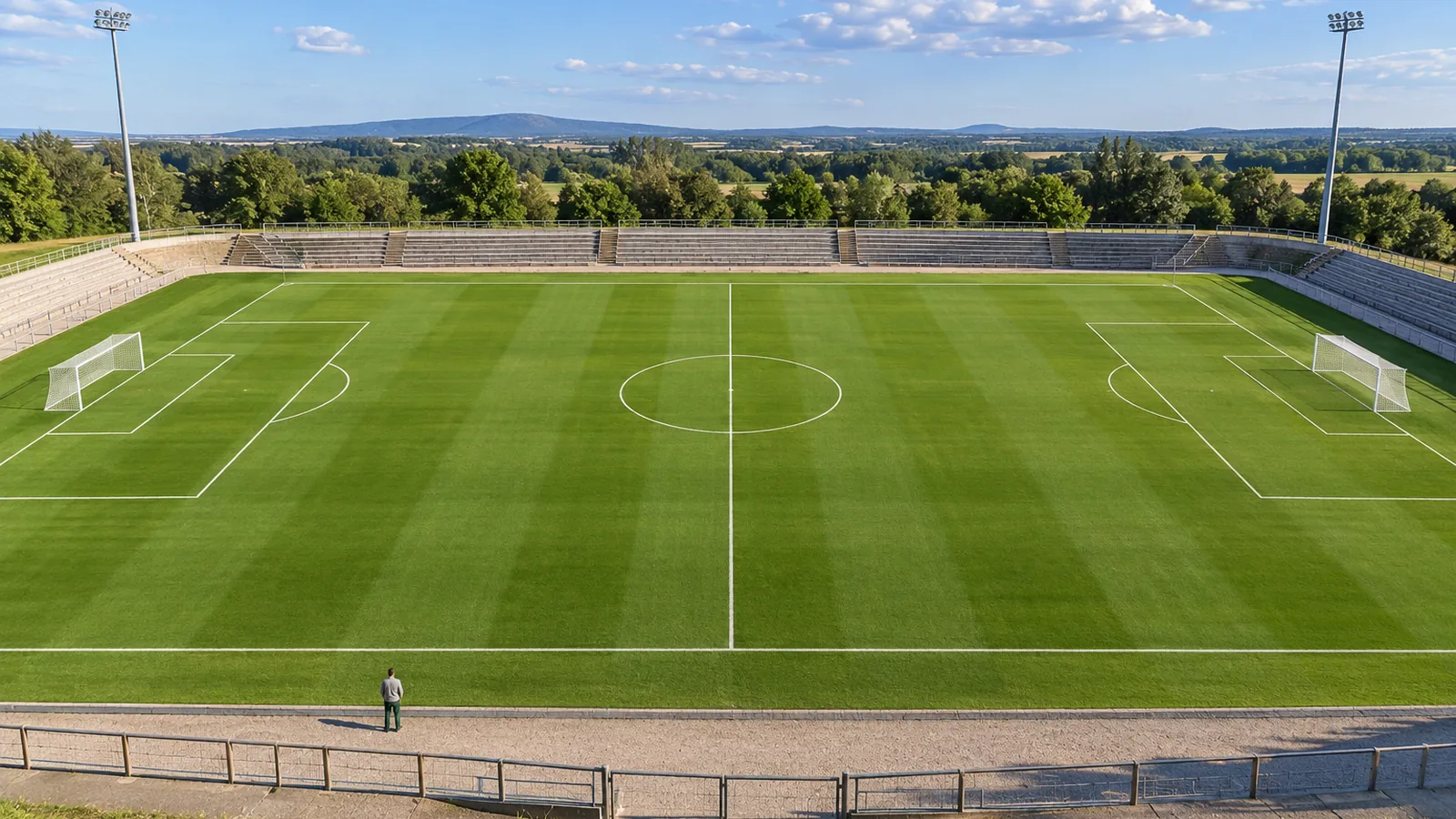
A commonly used full-size soccer field measures 105 × 68 meters (about 115 × 74 yards), FIFA’s recommended size, not a measured average (as listed in 2026) (quality.fifa.com). The actual permitted dimensions vary by competition: IFAB allows broader limits for ordinary matches and narrower ones for international matches under its 2025/26 Laws of the Game (downloads.theifab.com).
What is the average soccer field size?
Quick answer: There’s no measured average in the cited rules. For a full-size field, use FIFA’s recommended dimensions of 105 × 68 m (about 115 × 74 yd) (as listed in 2026); the permitted size changes with the competition, so check its rules before marking the field (downloads.theifab.com).
- FIFA recommendation: 105 × 68 m; the recommendation is undated (as listed in 2026) (quality.fifa.com).
- Ordinary match limits: 90–120 m long × 45–90 m wide under the 2025/26 Laws of the Game.
- International match limits: 100–110 m long × 64–75 m wide under the 2025/26 Laws of the Game.
Soccer lists a maximum of 30 × 20 yd, with no publication year stated; EPYSA recommends 25–35 yd long × 15–25 yd wide in April 2025 (cdn4.sportngin.com). Soccer lists a maximum of 47 × 30 yd, with no publication year stated; EPYSA recommends 55–65 yd long × 35–45 yd wide in April 2025 (cdn4.sportngin.com).
Which dimensions do match rules permit?
Ordinary match fields can fall within the permitted limits in the table; international matches use a narrower range, and FIFA’s recommended dimensions are not a survey-derived average.
| Field type | Length (m) | Width (m) | Year |
|---|---|---|---|
| Ordinary match | 90–120 | 45–90 | 2025/26 |
| International match | 100–110 | 64–75 | 2025/26 |
| FIFA recommendation | 105 | 68 | Undated |
The recommended field covers 7,140 m², calculated from FIFA’s recommended dimensions (as listed in 2026); that is about 76,854 ft² or 1.764 acres. The area conversions are calculations, not separately reported FIFA measurements.
Treat the ordinary and international figures as permitted limits, not typical measurements or averages. Competitions select dimensions within the applicable limits, and the touchline must be longer than the goal line.
How do youth field sizes vary by format?
Youth field dimensions vary by format, with U.S. Soccer listing maximums and EPYSA giving recommended ranges. These are setup guidelines, not measured averages or universal requirements.
| Format / age group | U.S. Soccer maximum (yd) | EPYSA recommended range (yd) | Year |
|---|---|---|---|
| 4v4 / U6–U8 | 30 × 20 | 25–35 long × 15–25 wide | — / 2025 |
| 7v7 / U9–U10 | 47 × 30 | 55–65 long × 35–45 wide | — / 2025 |
| 9v9 / U11–U12 | 75 × 47 | 70–80 long × 45–55 wide | — / 2025 |
The U.S. Soccer chart has no publication year stated; EPYSA’s standards sheets are dated April 2025. The figures serve different purposes: one sets maximums, while the other offers ranges for field setup. Check your league’s rules before marking a field, since neither source establishes a single size for every competition.
What changes a field’s dimensions?
Competition rules set the permitted field dimensions, and each competition selects its size within those limits; international matches have narrower limits.
- 90–120 m × 45–90 m is the permitted length and width for ordinary match fields under the 2025/26 Laws of the Game.
- Measurements run to the outside edges of the boundary lines, which count as part of the areas they enclose under IFAB’s field-measurement rule (theifab.com).
How does pitch size affect training?
A larger area per player generally increases total distance and high-speed running in small-sided soccer games, so expand the playing area when you want to raise those physical demands (pmc.ncbi.nlm.nih.gov).
- More area per player: A recent systematic review found that increasing the area generally increased total distance and high-speed running across the studies it reviewed; the review’s publication year isn’t stated (pmc.ncbi.nlm.nih.gov).
- 150–250 m² per player: One study linked this area to reproducing U19 match physical and physiological demands (as listed in 2026); it is not a universal training-grid target, and the study year isn’t stated.
- 2023 review: A systematic review and meta-analysis examined how relative pitch area affects small-sided-game demands, but did not set a universal small or large pitch size (pmc.ncbi.nlm.nih.gov).
Use area per player as a way to shape the session’s physical demands, rather than treating one grid size as right for every group or goal.
How have field-size recommendations changed?
Field-size guidance has three dated reference points, but they describe different rule sets and recommendations, not a measured change in average field size.
| Document | Date | What it describes |
|---|---|---|
| US Youth Soccer Player Development Model | October 2013 | Age-based field-size recommendations |
| IFAB Laws of the Game | 2025/26 | Permitted dimensions for match fields |
| EPYSA youth standards sheets | April 2025 | Recommended ranges for youth field formats |
These entries aren’t successive editions of one shared standard: one groups recommendations by age, one sets limits for match fields, and one gives youth-format ranges. The dates alone don’t show a trend because the documents measure different things and don’t report results from a survey of field dimensions.
For a field decision, start with the rules for your competition and age group, then check whether the applicable guidance gives a maximum or a recommended range. Treat the 2013 model as age-based guidance, not as evidence of what fields measured at that time (usyouthsoccer.org). The U.S. Soccer chart’s publication year isn’t stated, so it can’t be placed on this timeline as a dated reference point.
Frequently Asked Questions
How do I mark out a soccer field with cones or other training equipment?
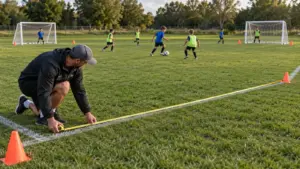
Use cones to mark the corners and sides of a temporary training grid, measuring the length and width your session needs. For match play, mark a rectangular field with continuous, non-dangerous lines; cones don’t replace compliant boundary lines under the 2025/26 Laws of the Game (theifab.com).
What equipment do I need to mark a soccer field?
For a match field, you need materials to create continuous, non-dangerous boundary lines; for a temporary training grid, cones can mark the corners and edges.
Can cones replace painted lines on a match field?
Cones are suitable for marking temporary training grids instead.
How much space should I allow around a soccer field?
Allow space beyond the field dimensions for any surrounding areas your site requires; FIFA’s recommended field dimensions exclude those areas. FIFA recommends at least 1 m of safety space beyond the touchlines and 2 m beyond the goal lines (as listed in 2026), so check your competition and facility requirements before setting the boundary.
How do I convert soccer field dimensions from meters to feet?
For example, FIFA’s recommended dimensions convert to about 115 × 74 yards, while the field area converts to about 76,854 ft² (as listed in 2026).
Conclusion
Which dimensions do match rules permit?
International matches have a narrower permitted range: 100–110 m long and 64–75 m wide (2025/26 rules).
How We Researched This
Soccer and FIFA.
- Coverage: the figures refer to 2013 to 2025; each one names its own year and source.
- Where sources disagree, the article reports both figures with their sources instead of averaging them.
- We used published records and maker or agency pages only; we did not run tests or surveys, and figures can change after publication.
Sources
- Inside FIFA (quality.fifa.com)
- 1 Laws of the Game 25/26 (downloads.theifab.com)
- cdn4.sportngin.com (cdn4.sportngin.com)
- epysa.org (epysa.org)
- epysa.org (epysa.org)
- nist.gov (nist.gov)
- epysa.org (epysa.org)
- Law 1 – The Field of Play (theifab.com)
- pmc.ncbi.nlm.nih.gov (pmc.ncbi.nlm.nih.gov)
- Effects of pitch size on soccer players’ physiological, physical, technical, and tactical responses during small-sided games: a meta-analytical comparison (pmc.ncbi.nlm.nih.gov)
- usyouthsoccer.org (usyouthsoccer.org)